Welcome to BoBo Feed


BoBo is a French expression, short for Bourgeois Bohème, and it pretty much describes who we are.

Bobo Feed will be sharing things that inspire us or please us-
from the worlds of architecture & design, fashion & styling, food and drink, travel, urban living, whatever...

We hope you enjoy.

.....................................................................................................................................................................
Showing posts with label Postcard from.... Show all posts

Friday, April 29, 2011

Postcard from Paris: the 12e and a visit to Marché d'Aligre

A piece on David Lebovitz's facebook page today caught our eye and brought back a flood of memories from our trip to Paris in the autumn of 2010. David shared a link to a nice little article by Alexandra Schwartz in The Atlantic (online- here) about the Marché d'Aligre in Paris' 12th arrondissement. The premise of the article is that Paris, in many of the areas frequented by most visitors, has been sanitized to within an inch of its life, and to get back to la vrai chose she suggests a visit to what she terms "the city's last great daily market". We had the great pleasure of spending a week in a splendidly charming apartment just a stone's throw from the Marché d'Aligre, and we can vouch for it being a jewel.

The 11th and 12th Arrondissements lie to the east of Le Marais and Place de la Bastille, and since the area's inception the settlements to the north and south of Rue du Faubourg Saint-Antoine (which divides the two boroughs) have housed the workshops and homes of Parisians who make things. Long in the past they crafted furniture & housewares that served the royal court at nearby Place des Vosges. In the 1990s artists discovered the underutilized atelier spaces in the area's disctinctive courtyards, and as usually happens, where the artists head the modern-day gentry soon follow. Nowdays the cours and passages are populated with design firms and ad agencies along with the occasional exquisite boutique. A little further to the east the area's population is made up more of immigrant communities. And at the crossroads of these two zones lies Marché d'Aligre.
The market structure, technically known as Marché Beauvau, is a beauty. A solid little building constructed of the native limestone with a clerestory light monitor atop, the interior is light-filled and proudly shows off its utilitarian yet delicate timber posts and beams. The shops inside, while certainly not over the top by Parisian standards, are decidedly more bourgeois than the vendors that fill the place and rue d'Aligre outside. 
And yet the assemblage does indeed feel like the real thing, probably because you know that you're pretty much the only non-residents in the vicinity. The bobos who can afford the spectacular flowers inside the market's doors are more than happy to rub shoulders with their Algerian neighbours as they both negotiate the best price for undergarments at the table up the street. At the end of the day, they are all just modern working families shopping at their local market, the way it's always been done.
We truly hope that this is one corner of Paris that does get overlooked by the scrubbing brigade. An honest, hardworking little market should be left to do what it does best- to simply serve its community according to their needs without having to worry about wearing its Sunday best in front of the visitors.
*******

Marché Beauvau
place d'Aligre
75012, Paris

Marché d'Aligre
place d'Aligre & rue d'Aligre
75012, Paris

Sunday, April 10, 2011

Postcard from Vieques- Isabel's Faded Beauty

Although she moves a little slowly these days, and she often has a worn down look about her, particularly to those who only glimpse her out and about in public on the main streets, if you take the time to stop and engage her you will quickly learn that Isabel was in her day a young beauty. Whereas today she must unceasingly tend to her matriarchal responsibilities for her large and dependent family (and consequently wears that burden like a tattered old dress), she once-upon-a-time set the hearts of many a young sailor aflutter.

Next time you see Isabel, take a morning or an afternoon to ask her about her colourful past. Stroll slowly along her quiet backstreets taking the time to look closely at the now faded charm she once possessed. If you do, we promise you'll leave her with an appreciation for her strength and dignity. And you'll understand the pull she once had on the hearts of young men.
 *****
 *****
 *****
 *****
 *****
*****
*****
*****
 *****

Friday, April 8, 2011

Postcard from Vieques- Bacalao

We're not sure of the origins of Bacalao- Salt Cod- but we tend to associate it most strongly with the Iberian peninsula countries of Spain and Portugal. We first sampled it in Barcelona where it was served in a tomato sauce. A perfect combination of mild saltiness and slight sweetness, it was a revelation.

To us, the very name sounds Portuguese, so it came as no surprise to encounter it in Brazil. This time it presented itself as small deep-fried croquettes served alongside Chopp, the icy cold draft beer much loved in that country. Move over chicken wings! We've found the world's best bar snack!

And we knew that the fortunes of Canada's most eastern province, Newfoundland, were once dependent on the harvesting and salt- curing of codfish, from where it would be sent back to the old world and, we presume, to the southern islands. Indeed, we were aware from having seen it in abundance in the West Indian food shops of Toronto that salt cod is a Caribbean staple. Why the heck, then, had we never tried to cook with it?
Well, truthfully, we had- once- and it was here in Vieques (where we are currently vacationing) where we failed so miserably in that task. The Puerto Rican cookbook we had brought down with us advised to soak the fish for 3- 4 hours before preparing the dish. Sounded easy enough! We immersed the hard plank of a filet for the afternoon, dutifully changing the water several times. We followed the recipe's preparation instructions and sat down expectantly to feast on our labours. We bit in and...YEOWW!!! Searing, excruciating salt! Tongues on fire! Gulping water! Dumping dinner down the toilet!

Having been once burned (literally!) by this humble foodstuff, it would take us a few years to muster the courage to try again. Of course we came to realize shortly after that first disaster that in fact one needs to soak salt cod for several DAYS, not hours. So this year we finally determined to give it another shot and this time we made sure we got an early start.

We bought the fish on Monday and immediately started the soaking. We changed the water about three times a day until we finally were ready to cook with it on Thursday. Since we often make crabcakes at home, we had decided to adapt our usual approach and make bacalao cakes. When we removed the fish from the water we realized that it had expanded somewhat and that there would be enough for another dish as well, so we opted to also prepare a tomato sauce- based fish stew.
Here are the rough recipes (sorry, measurements are imprecise!). All ingredients including the wines are easily available at supermarkets on Vieques. Each recipe serves 2- 4, depending on your appetite!

Basic Preparation of Salt Cod:
Soak the salt cod in ample water for 3 days, changing the water three times per day. Store the cod, covered, in the fridge throughout the soaking process.
In a saucepan large enough to hold the cod in a single layer, cover the fish with milk and poach very gently for about 5 minutes. Test for done-ness by flaking the fish at the thickest point- it should separate easily and the exposed flesh should look slightly under cooked- and if ready, remove and cool for future use. (don't overcook, or the fish will become tough) Reserve a little of the poaching milk for use in the cakes recipe.

Vieques Bacalao Cakes:
Ingredients
6- 8 oz. poached salt cod
1 medium potato
1/2 medium onion
1 cubanelle pepper
1 clove garlic
bread crumbs
1 egg (optional)
ground cumin
olive oil
black pepper
salt (optional)

Preparation
1. Cut the potatoes into chunks, boil then mash, adding a little of the reserved poaching milk. Set aside to cool.
2. Finely chop the onion, pepper, and garlic. Sautee in olive oil to make a soft sofrito. Stir in ground cumin to taste. Set aside to cool.
3. In a large bowl, break the cod into small pieces, being careful to remove any bones. Using two forks, flake the cod as finely as possible.
4. Add cooked potatoes and sofrito to the flaked cod and mix together thoroughly.
5. Taste and add a little salt if necessary (we had soaked our cod so well that this was necessary.)
6. Our mixture was quite moist and held together well when formed into a test patty, but if yours is a little dry, add the optional egg and thoroughly re-mix.
7. Chill until ready to use
8. When ready to cook, heat the olive oil in a large sautee pan, form the cod mixture into 4 cakes about 1" thick, dredge the cakes in the breadcrumbs, and gently place each cake into the hot oil. (Don't overcrowd them)
9. When the bottoms have become golden, carefully flip the cakes & continue cooking till gold on the 2nd side. Remove from the pan & drain briefly on paper towels.
10. Serve immediately with a few dollops of tartar sauce (see below) on each cake. We served ours with a crisp green salad and hearty Spanish vino tinto

Tartar Sauce
6 green olives, drained, pitted and finely chopped
1 Tbsp drained capers, finely chopped
1/4 cup of mayonnaise
1/2 tsp of sugar
1 Tbsp sherry vinegar (or acid of your choice)

Whisk the sugar into the vinegar to dissolve. Blend the sweetened vinegar, olives, capers into the mayo, making a smooth and fairly thick sauce.


********

Vieques Bacalao Stew:
Ingredients
6- 8 oz poached salt cod, broken into small chunks
1/2 medium onion
1 cubanelle pepper

1 medium carrot
1 clove of garlic, minced
1 small can pimentos (two whole sweet red peppers in brine)
1 28 oz can of stewed tomatoes
4- 6 green olives, drained, pitted and halved
1 1/2 Tbsp capers, drained
1 tsp ground cumin (or to taste)
olive oil
2 cups cooked rice prepared according to package directions, and timed to coincide with completion of stew


Preparation
1. Chop the onion, carrot and pepper coarsely into 1/2" dice.
2. Over medium heat, warm about 2 Tbsp of olive oil in a wide sautee pan. Add the onion, carrot, and pepper, reduce the heat to medium low, and cook gently till the carrots have softened but are not completely cooked through.
3. Cut the pimentos into 1/2" chunks and add to the sofrito.
4. Add tomatoes, cumin and garlic and stir to incorporate, then simmer gently for about 10 minutes.
5. Gently fold in the cod, olives, and capers and simmer another 6- 8 minutes, till the fish has warmed through but has not overcooked.
6. Divide the rice into serving bowls and ladle the stew into the bowls. Serve immediately. We had a nice Spanish Tempranillo with this.

*******
Buen Provecho!!


Thursday, March 17, 2011

Postcard from Vancouver (1)

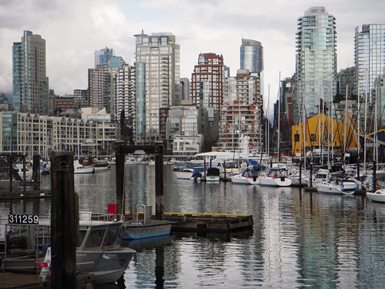
One of Vancouver's joys (and there are many) is its connection with the water. Its sea-side setting contributes hugely to the beauty of the city, factors prominently in the active lifestyles of its residents, and of course provides a bounty of delicious things for the seafood lover to consume.

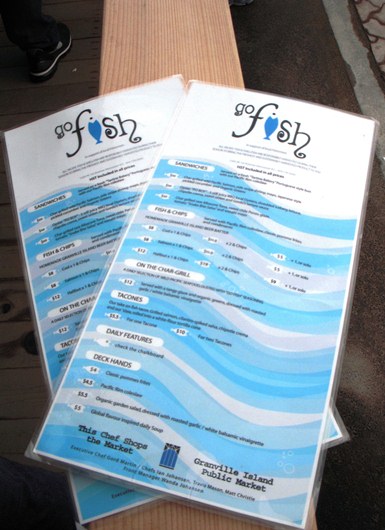
We recently spent a Saturday touring the town on a bicycle, and just as our energy was starting to flag in the early afternoon we stumbled upon Go Fish. We had heard of the place from a colleague, but had been told it was on Granville Island, which is not accurate. We were riding on the southern False Creek Seawall (headed for Granville Island in fact) on a section that wasn't right at the water's edge.  As we rounded a bend heading back towards the water we noticed some folks standing at the railing devouring take-away food. A quick head swivel and we saw that tucked behind some trees was a sidewalk leading off the bike path onto a working wharf. With the scent of French Fries in the air we decided it was time to explore!

Dismounting, we walked our bike through the opening and there it was- a bright blue shipping container with an open serving window and a half dozen folks lined up to order. As we cast our eyes a little further, we noticed a large wooden dining deck attached to the side of the container, and a lot more people!! Mostly just standing around waiting!
 Not to be dissuaded by the crowd, we got in line and placed our order for halibut and chips. Despite the array of "fancy" take-away on offer, being at the source on this singular occasion we craved the classic. (OK, we'd have to tolerate the "pacific rim" coleslaw, but after tasting it we had no quibbles.)

With a little time on our hands- estimated wait: 25 minutes- we explored our immediate environs. Down the gangway was a floating dock where there were moored a couple of fishing boats selling their fresh wares. We briefly contemplated the logistics of stuffing a salmon in our carry-on but decided we were going to have to settle for simply living in the moment, with only the memories (and this post!) as a souvenir.
We nabbed a stool at about the 15 minute mark and nursed our soda. Soon enough our name was called and we were presented with an overflowing basket of fries topped with a couple of slabs of golden battered fish, a cup of tasty slaw and the requisite tartar sauce. YUMM!! The air was cool, the skies were threatening (idly so, as it turned out), the fish was steaming hot, and we were ravenous! We were also in heaven. Heaven-by-the-Sea.

*******
Go Fish
1505 West 1st Avenue
Vancouver, BC V6J 1E8

Saturday, February 5, 2011

Postcard from... Prague

We've just recently hit the one year milestone here at Bobo Feed and to help celebrate we're launching a new feature that we plan to make a regular one: "Postcard from..." 

Our first dispatch comes to us courtesy of Diane Curry, a vivacious lady who became an instant friend after  we met her and husband Michael in Vieques, Puerto Rico a few years back. Since those days the adventurous pair have completed a sojourn in Singapore and have now moved on to the Czech  Republic, where their dog can finally run free and Diane can once more indulge her mustard fetish!

Postcard from Prague
Cool Air.  Bodacious beers.  Dogs and their lovers everywhere – on trams, trains, in restaurants – running loose, playing freely, scary to no one. Bread so varied and abundant it inspires poetry,  whole aisles of yogurt, cream and lactose loveliness, wines from the countryside that conquer their critics and a smothering of sausages –  cooked, smoked, curled, grilled, baked, aged, but mostly just speared and carried as street food. What did we feel so soon and so clearly?  Relief.  A Homecoming. Soothed and Enticed.  Europe, bless your historic, cultured, civilized soul...

...Strange as it seems after all these years on multiple continents, this is the longest time either of us has lived in a proper big city – Singapore was a big fabricated city – good in a zillion ways, but just not real in a dozen other ways. It hit me right away – cities are teeming with activity and all space is shared space.  Life is being lived pretty much on the move and Prague is a sensory playground for the newcomer. There’s so much classical music being played here that on my daily commute I see more people carrying musical instruments than I’ve seen anywhere, in my life.  And everyone is eating – usually chocolate or poppy seed croissants (my day to indulge in this breakfast is still ahead of me … the anticipation being part of the pleasure) or sausages in wardrobes of great variety.  As a lifetime mustard lover, I am thrilled to be back in a place where I can slather and dredge this condiment with abandon.  Contrarily, I’ve learned the hard way that “Americka style” is code-speak for mayonnaise, and sushi is one place wherein this detestable-to-me but loved-by-many foodstuff just doesn’t belong.  Prague is the land of potato soup and borscht, a veritable menagerie of roasted meats and doughy dumplings.  Gone are the tropical scented meals laced with lemongrass and coconut and chilies.  Czechs don’t like hot and spicy.  A chef of a new Indian restaurant here confessed to racial profiling:  he turns down the heat when Czechs are eating and cranks it back up for everyone else.  Thankfully, the Italians are here in large numbers and so is ALL of their good food.  Asia forced me to fantasize about good cheese, here it’s part of my everyday joy.  I just realized how much I’ve written here about food, and that’s because when you are new to a country, and your shelter is decided, food is often a thrice-daily adventure full of lots of wrong turns and delectable discoveries.  Michael noticed recently that this is the first country we’ve lived in where there are four languages written on most products, none English.  We guess a lot, we’re usually lucky and I’m glad we’re good a winging it.  You may not realize how it feels to stand in the meat section and try to decipher chicken from duck, cow from deer. Graphic icons are lifesavers.  Last week I guessed that a word with a “z” in it might be my best bet for finding sour cream – got it right.  But there was that pastry that I swore was a cheesy strudel and it turned out to be a too-salty-too-take-home-to-the-dog egg pie.  When in doubt, stick to fruits and nuts.  Still ahead, and full of mystery of varying importance, are doctor and dentist visits, train travel and more trips to government offices...

...Keep in touch and I will try to Blog Prague again in a few months.
 
  photo above courtesy Michael Franco
top photo courtesy EuropeUpClose.com

This piece has been excerpted from Diane's blog Passages In Time. You can read the full account here.